Yale is a serious school, but it doesn’t feel sterile. Students are ambitious, but they're also deeply involved in theater, music, publications, debate societies, and campus traditions. It has all the resources of a world-class research institution, yet much of student life revolves around smaller communities and close relationships.
Yale receives applications from thousands of extraordinary students every year. Most are perfectly capable of succeeding academically. Admissions officers aren't trying to determine who can survive four years in New Haven, they're trying to imagine who will contribute to the type of community Yale has spent centuries building.
So how can you turn your experience and record into a Yale acceptance? Let’s get into it.
Who Actually Gets Into Yale?
The academic expectations are probably the easiest part of Yale admissions to understand.
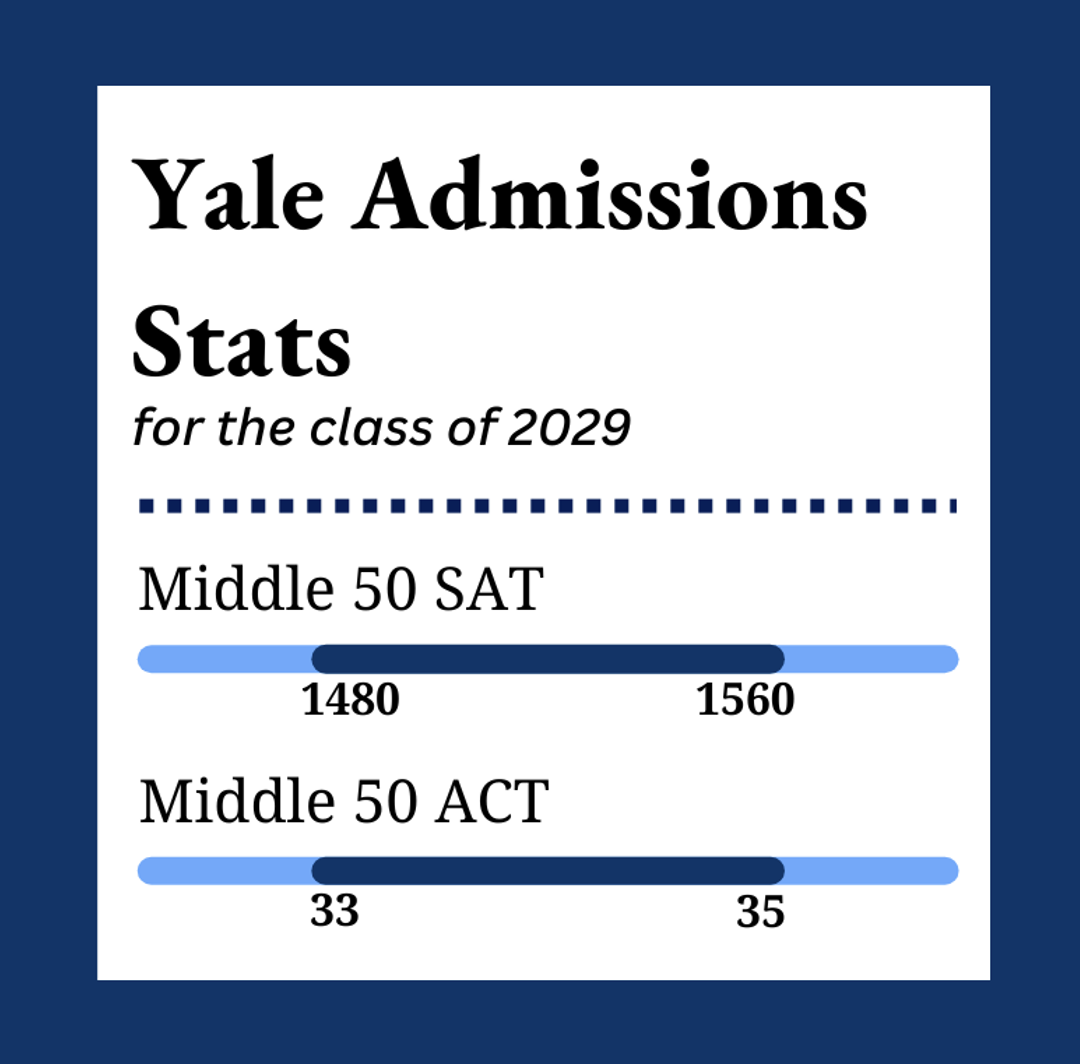
Students who enroll at Yale usually arrive with exceptional grades, demanding schedules, and testing that sits near the very top of the national applicant pool. Test scores are often in the 99th percentile, and GPAs are often 4.0s. Most successful applicants have exhausted the rigor available to them in high school, whether that means AP classes, IB courses, or dual enrollment.
Obviously, academics are foundational – they have to be! Where things become much less straightforward is after that initial hurdle.
Middle 50 Testing Data for Admitted and Enrolled Yale Freshmen:
| Test | 25th Percentile | 50th Percentile | 75th Percentile |
|---|---|---|---|
| SAT Composite | 1,480 | 1530 | 1560 |
| SAT Evidence-Based Reading + Writing | 730 | 760 | 780 |
| SAT Math | 740 | 780 | 790 |
| ACT Composite | 33 | 34 | 35 |
| ACT Math | 31 | 34 | 35 |
| ACT English | 34 | 35 | 36 |
Yale has access to an almost absurd number of students with pristine grades and elite scores. Every admissions cycle includes applicants with perfect transcripts, national awards, published research, nonprofit organizations, and enough leadership titles to fill a LinkedIn profile before they're old enough to vote.
Part of the reason outcomes seem unpredictable is that Yale is trying to identify students who will actually enjoy being there. Students who thrive in New Haven often possess strong intellectual interests, but they also become invested in on-campus activities like publications, a cappella groups, intramural sports, theater productions, research labs, or causes they genuinely care about.
Strong applicants usually possess impressive credentials, but their applications rarely feel like collections of credentials. There is generally some sense of personality running through them. You get a picture of someone who has interests, opinions, and enthusiasm for the things they spend their time on.
What Does Yale Really Want to See?
Families often assume that schools like Yale are searching for students who can do everything. Perfect grades, research, community service, awards, leadership positions, summer programs, music, athletics – the longer the list, the better.
Academic Factors Yale Considers:
| Academic Factors | Very Important | Important | Considered | Not Considered |
|---|---|---|---|---|
| Rigor of secondary school record | X | |||
| Class rank | X | |||
| Academic GPA | X | |||
| Standardized test scores | X | |||
| Application Essay | X | |||
| Recommendation(s) | X |
And we get it! Elite admissions has created an environment where many students feel like they need to become professional résumé builders, but Yale applications often become stronger when students stop trying to prove they can do everything and start demonstrating that they genuinely care about something.
Part of the reason academic niches matter so much is because they give admissions officers a clearer sense of who a student is likely to become once they arrive on campus. A student fascinated by public health may pursue biology courses, volunteer in healthcare settings, write for the school newspaper about healthcare policy, and spend summers conducting research. Somebody interested in architecture might become absorbed in urban planning, art history, and photography. A future historian may gravitate toward debate, archival research, writing, and community projects tied to civic engagement. And none of these students are following some magical Yale checklist. Their interests simply started to shape the choices they made, and Yale values that kind of intellectual ownership.
Nonacademic Factors Yale Considers:
| Academic Factors | Very Important | Important | Considered | Not Considered |
|---|---|---|---|---|
| Rigor of secondary school record | X | |||
| Class rank | X | |||
| Academic GPA | X | |||
| Standardized test scores | X | |||
| Application Essay | X | |||
| Recommendation(s) | X |
Part of what gives the university its culture is that students arrive with distinct passions and then spend four years exposing each other to those passions. Building an academic niche doesn't mean you have to become perfectly narrowly specialized at sixteen! It means providing admissions officers with evidence that your interests are genuine enough to influence how you spend your time.
How Does Yale Decide Who Gets in?
People spend a lot of time searching for the secret formula, which we wish there were – but there’s just not. (and admissions in general) doesn't really work that way.
The Yale admissions office has no shortage of exceptional applicants to sort through. They could fill several classes with students who have perfect grades and outstanding scores. Their challenge lies in selecting one class from thousands of equally impressive options.
The committee is also trying to build a campus community rather than a collection of résumés. Some students distinguish themselves through scientific research. Others through music, writing, debate, athletics, entrepreneurship, community engagement, or work experience. There are future engineers and poets, future doctors and documentary filmmakers. Yale has always wanted a variety of students, and its admissions process reflects that. And again, it doesn’t matter what you want to do, but that you actually went for it as much as possible.
Another piece families sometimes underestimate is personality. Not personality in the sense that everybody needs to be charismatic or extroverted, but personality in the sense that admissions officers are trying to understand who a student actually is and if they’ll be a good fit for the campus. Reading applications for long enough gives people a strange ability to tell when somebody is presenting a fake version of themselves versus describing the things that genuinely matter to them. This is one reason why essays are so important.
How Can I Get into Yale?
Tons of students spend years preparing transcripts, accumulating activities, and chasing accomplishments. A lot less spend the same amount of time thinking seriously about who they are, what they value, or what excites them intellectually. Yale wants you to be in that second group.
The university has always shown a preference for students who sound like actual people. Looking at successful Yale essays, you’ll get a sense of humor, curiosity, vulnerability, enthusiasm, or even occasional weirdness. Our students have written about family traditions, books they can't stop recommending, niche interests, silly stories, and ideas that genuinely matter to them.
Part of the reason Yale's essays carry so much weight is that they provide something grades cannot. A transcript tells the admissions office what classes a student took and what grades they got. The activities section tells them what you did outside of school. But essays reveal what occupies that student's mind when nobody is assigning homework! And that’s a lot more you than just doing school!
Activities still matter, obviously, but not because admissions officers are counting leadership positions. They are trying to understand how students spend their time and where they invest their energy. These kinds of strong applications emerge over time – your interests evolve as you discover what you genuinely enjoy and become better at articulating why those things matter to you. There is no magical summer program or hidden extracurricular combination that unlocks admission. Most successful applicants simply spent years becoming more invested in the things that already interested them.
How Can TKG Help?
At The Â鶹ԭ´´, we spend a great deal of time helping students figure out what genuinely excites them and how to pursue those interests thoughtfully over their high school career. Sometimes that means identifying research opportunities or summer programs, or encouraging a student to lean more heavily into writing, theater, community work, music, entrepreneurship, or independent projects that might otherwise get dismissed because they don't fit somebody's old-school idea of a "perfect" applicant.
We also guide students through the technical side of admissions. We help with class selection, test strategy, building college lists, Common App essay development, supplemental brainstorming, and even interviews. By the time applications are submitted, every piece should work together naturally rather than feeling like it was assembled by a committee.
Perhaps most importantly, we help students avoid that fake posturing and performing that Yale hates. The strongest applicants usually feel comfortable in their own skin and fit naturally into the Yale community. They reveal somebody with interests, values, quirks, and aspirations rather than somebody desperately trying to guess the right answers.
We don’t want to manufacture a Yale applicant – instead, our job is to help them communicate who they are with clarity and confidence.
Conclusion
Yale combines extraordinary academic rigor with a culture that remains deeply invested in people and communities. The residential colleges, the arts scene, the publications, the traditions, and the emphasis on discussion all create an environment that rewards students who enjoy being part of something larger than themselves.
Plenty of Yale applicants have perfect grades and extraordinary accomplishments, but what seems to separate many successful applicants is that they feel like people who will slot into Yale’s culture easily – all of which can be proven through building a smart strategy.
There is no shortage of brilliance at Yale. And if you want to be a part of that culture and campus, we can help. Reach out to us today to get started.
Need help getting into a Top 20 school? Reach out to us today.