Cornell is one of the most misunderstood schools in the Ivy League. People know the agriculture and hotel schools, but don’t always recognize the strength of their engineering, business, or liberal arts colleges. It combines the resources of a large major research university with the close-knit academic vibe people expect from an Ivy. That complexity shows up in their admissions, too.
Unlike some highly selective universities that might seem to search for a single type of applicant, Cornell is building multiple classes simultaneously across several undergraduate colleges, each with its own priorities, academic culture, and expectations. As a result, understanding how Cornell evaluates applicants requires looking beyond acceptance rates and test scores. You need to understand what the university is actually trying to build.
So who gets into Cornell? What separates one highly qualified applicant from another? And how can you position yourself as a strong fit for the specific Cornell college you're applying to? We’re here to help.
Who Actually Gets Into Cornell?
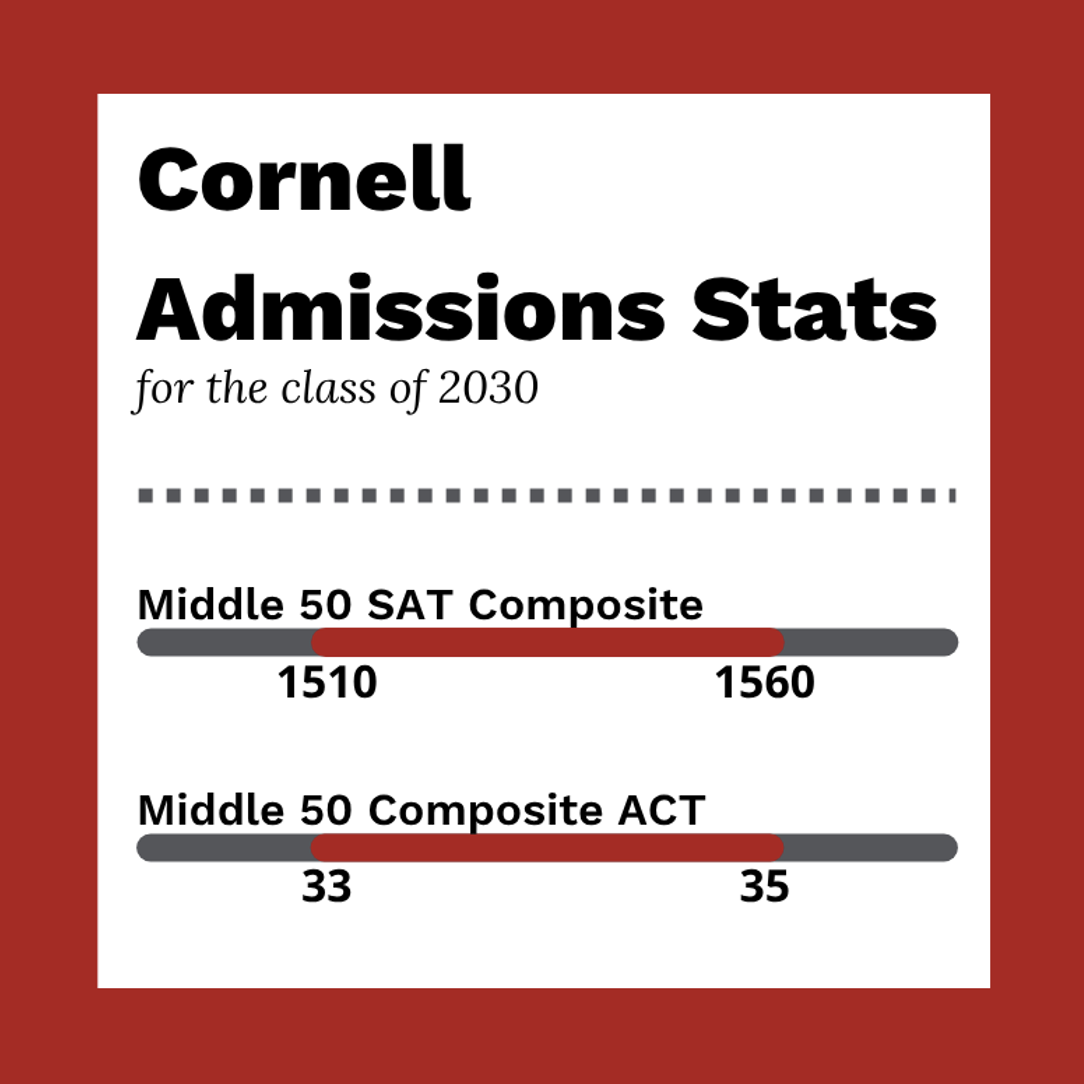
Cornell is an Ivy League school, but unlike some of its peers, it contains a wide range of colleges and programs that attract very different types of students. An aspiring engineer applying to Cornell Engineering is entering a very different admissions landscape than a student applying to the School of Industrial and Labor Relations, the College of Human Ecology, or the College of Agriculture and Life Sciences.
But no matter where you’re applying, there’s one thing that always matters: your grades and scores.
At any selective school, strong academics are the foundation. Cornell enrolls students who challenge themselves with rigorous coursework and perform exceptionally well in those classes. Standardized testing, class rank, and GPA all matter, and the published admissions data makes it clear that the vast majority of admitted students sit near the top of their graduating classes and are in the top percentiles of all standardized test takers.
The baseline is meeting these academic standards. However, Cornell admissions officers are not only asking if you're an impressive student on paper, they want to know if you’re going to be a fit.
| Score Range | SAT Evidence-Based Reading + Writing | SAT Math |
|---|---|---|
| 700-800 | 93.30% | 97.09% |
| 600-699 | 6.51% | 2.91% |
| 500-599 | 0.19% | 0% |
| 400-499 | 0% | 0% |
| Score Range | ACT Composite |
|---|---|
| 30-36 | 96.90% |
| 24-29 | 2.70% |
| 18-23 | 0.40% |
| 12-17 | 0% |
| City | Population, million | Density, men/km2 |
|---|---|---|
| New York | 8 537 673 | 4 042 000 |
| Los Angeles | 10 831 100 | 3 198 000 |
Tens of thousands of applicants every year have elite grades, strong scores, and challenging schedules. Once you reach that level, the question becomes less about whether you can handle Cornell academically and more about what you will contribute once you get there and what you’ll get out of a Cornell education.
The students who get into Cornell have a clear sense of academic direction. Their interests feel developed rather than accidental – they’re not just adding stuff to their resume to add it. Their application demonstrates that they've spent time exploring ideas, opportunities, and experiences related to what they want to study.
What Does Cornell Really Want to See?
Ivies don’t want to see well-roundedness. That’s a myth of the past. Cornell prefers students who have demonstrated meaningful engagement in one particular area of interest. Remember kids, developing some genuine intellectual curiosity tends to produce stronger applications than resume-building for its own sake.
Consider two students applying to Cornell's College of Engineering with the exact same grades and scores.
The first student has done everything they can at school. Student government. Varsity sports. National Honor Society. Engineering Club. Community service. A coding club. Several summer programs. A long list of leadership positions. There is absolutely nothing wrong with this profile.
The second student became fascinated by renewable energy during sophomore year. That interest led to engineering coursework, independent design projects, participation in robotics competitions, research with a local university lab, and the creation of a small community initiative to teach elementary students engineering basics.
Both students are super impressive, but one of these students has shown an advanced interest in engineering and has already taken it outside the classroom. They’re going with Student 2.
Cornell tends to respond strongly to students whose activities connect to a broader intellectual interest or purpose. One of the core tenets of Cornell is “any person, any research,” and the more you do before college, the better prepared you are for research once you’re there.
How Does Cornell Decide Who Gets in?
For a look into the room where it happens, read . Here’s a piece of the article that talks about how Cornell makes their decisions:
Unlike many other colleges, which review all applications from a central undergraduate admissions office, Cornell has a “somewhat unique system,” according to Locke. Once an application is submitted, it will be given to the one — and only — college or school that the student is applying to, where his or her material will undergo what Locke called a “first review.”
About 80 percent, or over 40,000 of the applicants, will be chosen to proceed to the next step. Only after the applicant has successfully passed the academic review, the admissions staff will consider other components of his or her application — such as recommendation letters and extracurricular activities, Tan said.
In the first review, the admissions staff of each college acts as gatekeepers by looking at the applicants’ academic performances to determine whether the student will do well at Cornell. This assessment relies on all scores and grades submitted by the students, but will place the heaviest weight on their high school records.
Those who make it to the next step are not the ones “that have E’s and F’s on their transcript,” Tan said. “Even if you are an outstanding student who’s a great fit for Cornell and have wonderful extracurricular activities ... there’s not much I can say about you.”
Students often imagine admissions committees sitting around a table ranking applicants from smartest to least smart. Admissions would be a lot easier to predict if this was true, but it’s just not how it works.
Cornell's process is far more nuanced because the university is trying to build multiple classes simultaneously across several colleges. As you saw in the article, your application is given to the college you want to apply to, and then if you pass the first round, you’ll continue on. Academic strength matters here, but admissions officers are also evaluating academic interests, institutional needs, personal qualities, extracurricular engagement, recommendations, essays, and overall fit. Especially when you consider the college you want to call home at Cornell is the first gatekeeper.
Cornell is looking at how the various pieces fit together. Do your academic interests align with your activities? Do your essays show depth and character? Does your intended major make sense given the experiences you’ve pursued?
Admissions officers also understand that students come from dramatically different educational environments. Some attend schools with extensive resources, dozens of AP classes, and research opportunities. Given Cornell’s distinction as the only Ivy with an agriculture program, this is something they very much take into consideration, especially with students from rural farming communities.
It’s okay if you didn’t have every opportunity imaginable – it matters what you actually did with the opportunities you actually had.
How Can I Get into Cornell?
Start by asking the right question: "What genuinely interests me?" Because if you just stuff the resume to stuff the resume, that’s not going to work, and admissions officers are going to notice.
A student interested in architecture might spend years sketching, designing, studying urban spaces, and creating independent projects. A future labor relations applicant might become involved in community advocacy, public policy initiatives, or local government. A prospective engineer may pursue robotics, research, programming, or design work outside the classroom. A prospective entrepreneur might start their own company, intern at a company aligned with their interests, or pursue research into other companies they admire.
As you can see, no matter the path, the amount of engagement and effort is what matters. This philosophy also applies to essays. One of the biggest mistakes applicants make is trying to sound like what they think an Ivy League student is supposed to sound like. The result is often stiff, overly formal writing that says very little about the person behind the application. Cornell will ask you about what you want to study, and having experiences and curiosity to draw upon for that (very long) essay will help you immensely.
Long-term planning also matters a lot more than students and parents realize. Strong Cornell applicants absolutely cannot build competitive applications overnight. Strong applications develop gradually through academic exploration, extracurricular involvement, meaningful mentorship, and intentional decision-making over several years. That’s why we say starting sophomore year is probably the best strategic move you can make.
How Can TKG Help?
Here at The Â鶹ԭ´´, we help students develop applications that are reflect their interests, showcase their strengths, and present them as who they are – not what they might think Cornell wants to see. Because guess what?? Cornell wants to see you!
We work one-on-one with students to identify their academic niche and assist them with building meaningful experiences around them over time. That might involve pursuing research opportunities, developing independent projects, refining extracurricular involvement, identifying summer programs, strengthening leadership experiences, or helping students build a clearer academic narrative. We help students down the “funnel,” if you will. Taking them from a big topic like engineering to something smaller like biomedical engineering – specifically for heart-related medical devices.
We also guide students through every major component of the admissions process, testing strategy, high school course selection, summer planning, Common App essay development, Cornell supplemental essays, interview preparation, and college list construction.
We believe in helping students present themselves clearly, strategically, and authentically. Those are the applications that work the strongest – especially when you add in the grades and scores to make it happen.
Conclusion
Cornell admissions can feel daunting because they’re looking for such a variety of students to fill their unique and interesting programs. But that doesn’t mean we can’t help you figure out the best approach for you.
Our clients who stand out the most are the ones who spend years developing their passions, building strong extracurricular profiles, and making sure the application they present is representative of who they are.
Understanding what Cornell values can make the process feel far less spooky. They want you to be excited about what they offer and show genuine curiosity – and we can help you do that!
Need help getting into a Top 20 school? Reach out to us today.