Brown has one of the most recognizable brands in higher education, but not for the reasons people usually think. Sure, it’s an Ivy League school, and sure, it’s wildly selective – but Brown has also cultivated a reputation for attracting and enrolling a very specific kind of student. They want intellectually curious, independent, creative, and maybe just a little bit unconventional students.
A lot of students approach Brown assuming it’s simply “An Ivy, but artsier.” Not quite! Brown’s admissions process rewards students who demonstrate genuine academic curiosity and self-direction, not just students who stacked their resumes with prestige-heavy activities. The challenge, of course, is that tons of students who apply to Brown are already extremely accomplished. So how does Brown actually decide who gets in? Let’s break it down!
Who Actually Gets Into Brown?
Before we get into essays, extracurriculars, and institutional priorities, we need to address the obvious: Brown is still an Ivy League school with extremely high academic expectations. There is no version of a competitive Brown applicant that is casually coasting through high school with mediocre academics. That’s not how this works.
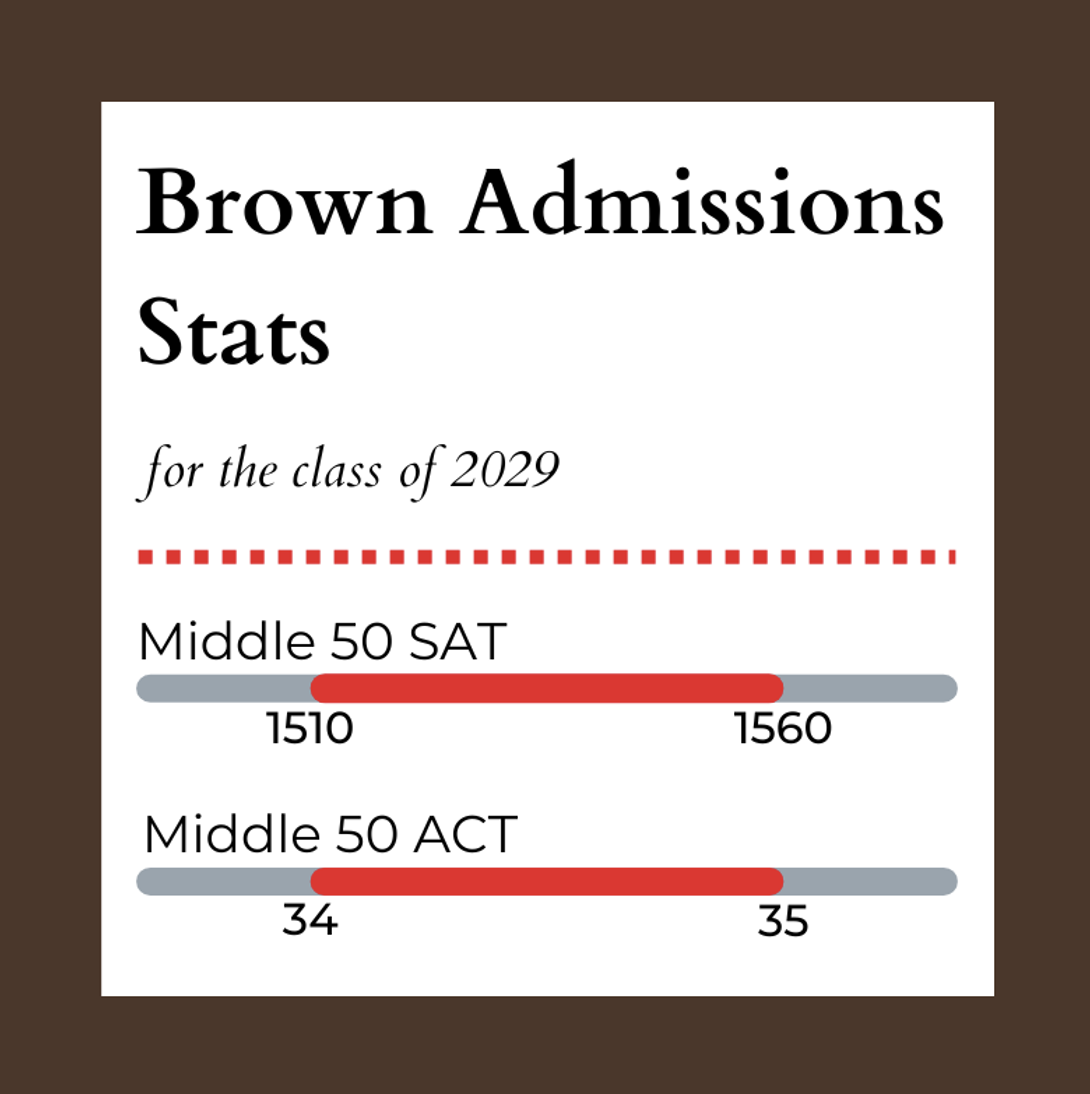
The numbers are intense. Last cycle, Brown admitted only a tiny percentage of applicants (5.39%), and the overwhelming majority of accepted students were near the top of their graduating class. Based on Brown’s published data, students are seeing standardized testing numbers in the 1500+ SAT or 34–36 ACT range to be academically competitive. Even then, those numbers are usually just the starting point.
| Test | 25th Percentile | 50th Percentile | 75th Percentile |
|---|---|---|---|
| SAT Composite | 1510 | 1540 | 1560 |
| SAT Evidence-Based Reading + Writing | 740 | 760 | 780 |
| SAT Math | 770 | 780 | 800 |
| ACT Composite | 34 | 35 | 35 |
| ACT Math | 32 | 34 | 35 |
| ACT English | 35 | 35 | 36 |
| ACT Science | 33 | 35 | 36 |
| Class Rank | Percentage |
|---|---|
| Top tenth of HS graduating class | 89% |
| Top quarter of HS graduating class | 98% |
| Top half of HS graduating class | 100% |
| Percent reporting class rank | 30.60% |
Brown receives thousands upon thousands of applicants with near-perfect grades, rigorous coursework, and elite test scores. Once you hit that threshold, admissions becomes much more about distinction, so what separates you from every other student with a 4.0 and a research internship?
Brown tends to value students who have built thoughtful, authentic academic and extracurricular identities. They like students who seem genuinely engaged with ideas, not just students trying to collect accomplishments like Pokémon cards.
What Does Brown Really Want to See?
One of the biggest misconceptions about Brown (and the Ivies in general) is that they’re looking for “well-rounded” students. In reality, Brown gravitates toward students who care deeply about something and pursue an interest because they are genuinely fascinated by it, not just because it looks “good” on an application.
Imagine two applicants with essentially identical grades and scores applying as prospective history majors.
Student 1 has done a little bit of everything: student government, multiple varsity sports, community service clubs, generic humanities summer programs, a variety of club leadership titles, NHS, etc., etc. They have an unweighted 4.0, tons of APs, and a 1560 on the SAT. The whole package. Very accomplished. Very impressive. Also… somewhat interchangeable.
Student 2, meanwhile, has spent years exploring one specific area within history, and narrowed down their focus from just “American History” to “America’s Involvement in Vietnam.” After taking a Vietnam War history course at a pre-college program, they started an independent research project on the impact of media coverage of Vietnam. They started a YouTube channel where they interviewed Vietnam War Veterans, volunteered at a local history museum, and made a short documentary about the war’s impact on their hometown. They spent two consecutive summers working with a professor, successfully lobbied to add a Vietnam History course as an elective at school, and they also had an unweighted 4.0, tons of APs, and a 1560 on the SAT.
Shocker – Brown will usually find Student 2 more compelling.
Why? Because Brown values intellectual engagement that feels real. They want students who pursue ideas outside the classroom simply because they want to understand them better. Not students who appear to be reverse-engineering their personality and resume around college admissions.
This passion will also show up in recommendation letters. Brown tends to respond strongly to students whose teachers describe them as curious contributors to the classroom environment: students who ask unusual questions, initiate conversations, or genuinely love learning for learning’s sake. That might sound cliché – until you realize Brown’s entire academic culture is kind of built around that concept.
How Does Brown’s Open Curriculum Impact Admissions?
One thing that makes Brown fundamentally different from many of its peer schools is the Open Curriculum. Unlike most colleges, Brown does not have general education requirements, and students largely design their own academic experience. No mandatory core classes, no “everyone has to take this science class” energy, and no freshman writing seminars. Students are expected to take ownership of their education from day one. Which, of course, means Brown has to admit students who can actually handle that freedom.
The Open Curriculum works beautifully for students who are intrinsically motivated and excited about exploration. It works far less well for students who need heavy external structure in order to engage academically. Brown knows this, which is why they pay close attention to evidence of self-direction throughout an application – hence Student 2's advantage.
Students who thrive at Brown often demonstrate intellectual initiative long before college. They independently explore niche academic interests, pursue interdisciplinary projects, start creative ventures, or connect ideas across different fields in unusual ways. Brown loves students who seem to have already embraced their ideology through their applications.
How Does Brown Decide Who Gets in?
Unfortunately, there is no perfectly simple and transparent formula. There aren’t for any Ivies, but we do know that like most schools, they make decisions as a committee. According to an article in from February 2026, here are some things Brown Admission officers care about:
Prospective students frequently ask Berman what makes someone a strong applicant to Brown, but there is no single quality in every successful admit, he said.
“Frankly, I think Brown would be a boring place if we were looking for one set of criteria from each applicant,” Berman said. But the admissions office hopes to “set students up to be academically successful at Brown,” so they try to admit students who will be able to handle the rigorous course load, he added.
Admissions officers also look for students who are engaged with their communities and will get involved with the Brown community in a variety of disciplines, from performing arts to athletics to comedy, Berman said.
Another key aspect the admissions committee considers is how prospective students will fit in with Brown’s Open Curriculum, and excel with “flexibility and choice,” Berman added.
Like most elite colleges, Brown uses a holistic admissions process, meaning they evaluate students across multiple categories at once rather than plugging numbers into some magical admissions spreadsheet. Academics matter enormously, your essays matter enormously, activities matter enormously, recommendations matter enormously, and even the video introduction they use matters enormously. However, institutional priorities matter too.
What we do know is that Brown tends to value applicants who feel multidimensional but grounded. Students with strong academic voices, who contribute positive energy to a campus community, and who seem likely to actually use Brown’s flexibility in interesting ways.
How Can I Get into Brown?
A lot of students think getting into Brown is about appearing quirky – it’s not. Brown does not need manufactured ~quirky~. What Brown actually wants is intellectual authenticity.
That means your application should demonstrate genuine curiosity, thoughtful engagement, and a clear sense of who you are, both academically and personally. The strongest Brown applicants usually have a clear throughline connecting their interests, activities, coursework, and essays, and their applications feel cohesive without being overly polished or artificial.
Another important piece of the puzzle is the application essays. Brown’s prompts are designed to reveal how you think, not just what you’ve accomplished. They want students who will genuinely take advantage of the Open Curriculum and contribute to Brown’s collaborative campus culture. Unfortunately, this is also where many applicants accidentally sabotage themselves. They try too hard to sound “smart.” The essays become stiff, overly formal, and exhausting to read. Brown already knows you’re academically capable from your transcript. What they’re trying to figure out is who you are.
One thing we consistently see among successful Brown applicants is intentionality over time. Their applications tell a story! And realistically, most students benefit from guidance while doing this.
Applying to schools like Brown often requires long-term strategic planning around academics, extracurricular development, summer opportunities, essays, and positioning within an increasingly competitive applicant pool. A strong private college counselor cannot magically “get” someone into Brown, but experienced guidance can absolutely help students clarify their strengths, identify meaningful opportunities, avoid common mistakes, and build a far more cohesive application narrative over time.
At the end of the day, there is no guaranteed formula for Brown admissions. But as we’ve discussed, the strongest applicants usually share several traits: exceptional academics, clear intellectual interests, meaningful extracurricular depth, self-direction, and essays that sound like they were written by an actual human being instead of a LinkedIn profile.
How Can TKG Help?
At The Â鶹ԭ´´, we help students build applications that feel intentional, differentiated, and strategically aligned with what highly selective colleges are actually looking for. Because, contrary to popular belief, strong applications rarely come together accidentally.
We work one-on-one with students to identify genuine areas of academic and extracurricular interest, then help them develop those interests into compelling long-term narratives throughout high school. That might mean refining a broad interest into a more specific academic niche, helping students identify meaningful summer programs or research opportunities, brainstorming independent projects, strengthening leadership initiatives, or shaping an activities profile that tells a clearer and more cohesive story.
We also help students navigate the parts of the process that are often hardest to manage on their own: Common App essay brainstorming and editing, supplemental essay strategy, interview preparation, HS course selection, testing strategy, and building balanced school lists. Throughout the process, our goal is never to manufacture some fake “Brown applicant,” that approach usually backfires. Instead, we help students present the strongest, clearest, and most authentic version of themselves possible.
Conclusion
Brown admissions is competitive because Brown is trying to build a very particular kind of class. They are not simply admitting students with the highest numbers. They are admitting students who seem intellectually alive, ones who will take advantage of the freedom, flexibility, and collaborative energy that define Brown’s campus culture.
The students who stand out at Brown are usually not the ones joining random clubs purely for resume padding. Their applications evolve naturally over time around real interests and genuine curiosity. Even when their path is still developing, there’s intentionality behind it.
Understanding what Brown actually values can help you position yourself much more effectively. The goal is not to reinvent yourself for college admissions. It’s to build and present the strongest, clearest, and most compelling version of who you already are.
Need help getting into a Top 20 school? Reach out to us today.